
We created Blackouts as a way for you to stream silence during a predetermined time. Certain streams (especially ones broadcasting football, basketball, and other sports content) are not permitted for online streaming as the leagues' policy only provides permission for certain approved broadcasts. As such, they need to be able to blackout their online streams when these events happen.
To create a blackout, you will need to access Stream and then select Publishers from the menu on the left. Click on a specific publisher. Next, click on the Create button located in the top-right corner of your screen and then click Blackout.

In the Create blackout screen, you can select the date and time you want the blackout to start, along with the duration.

NOTE: When creating a blackout, ensure that the timezone displayed is correct. If it needs to be changed, navigate to the Configuration tab under the desired publisher, set the correct timezone, and click Save.
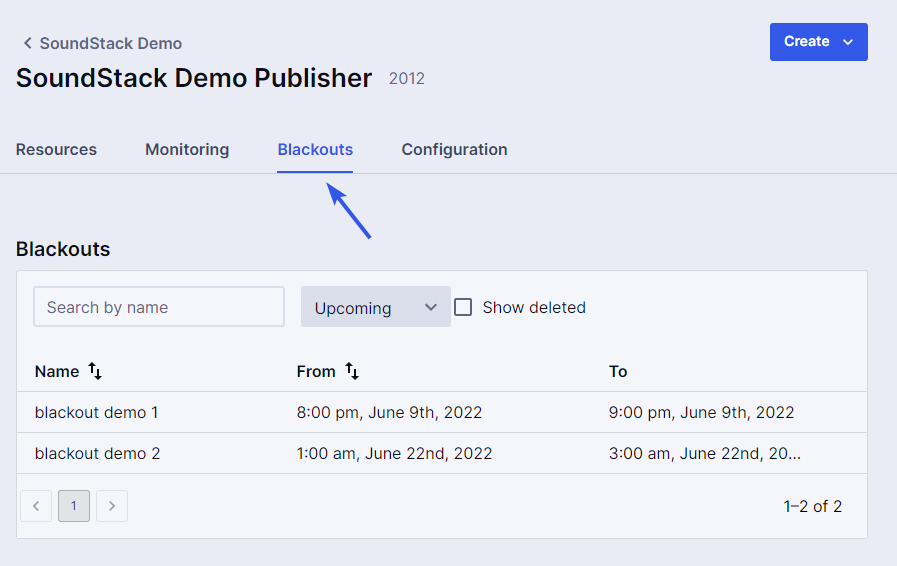
Your list of configured blackouts can be viewed by accessing the Blackouts tab for that specific publisher.

Connection Rules
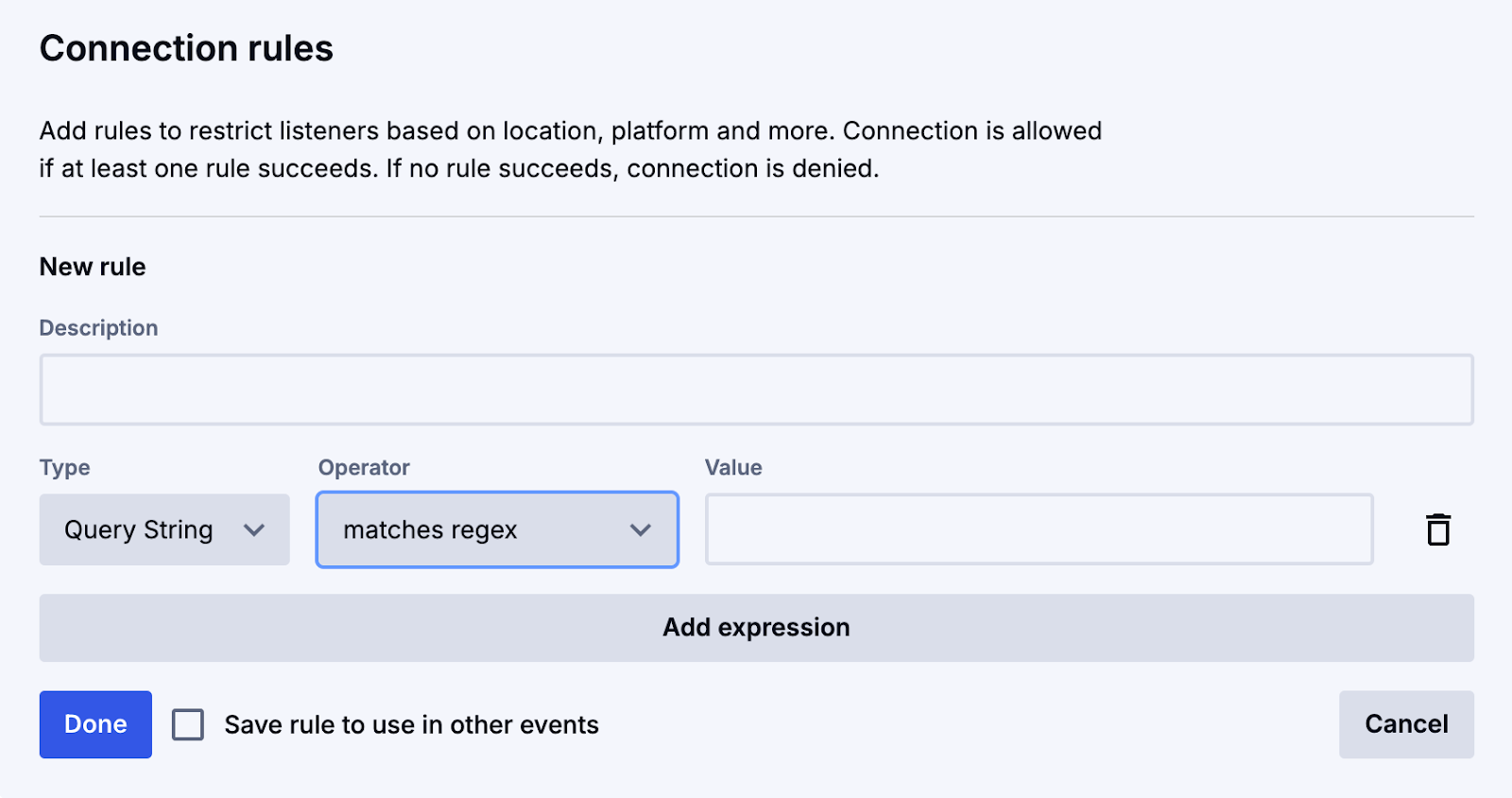
You can selectively include or exclude listeners from your blackouts. You can have multiple rules. If a listener matches any of your rules, they will be able to connect to your feed.
Add a descriptive title of the rule, so you can find and modify it later. Then, set the rule type:
- Location: Used to set geographical blackouts, often used for sport broadcasts
- Operator: Determines if the rule will be used to block everyone inside a zone or outside a zone
- Is in: Any listener within the specified location radius will be able to connect to the stream
- Is not in: Any listener not within the specified location radius will be able to connect to the stream
- Latitude/Longitude: The geographical coordinates for your rule
- Wikipedia has the geographical coordinates for most cities in the world
- Enter the values in decimal format
- For latitude, North values are positive numbers, South values are negative numbers
- For longitude, East values are positive numbers, West values are negative numbers
- For example (N 23, W 102)
- Enter 23 into the Latitude field
- Enter -102 in the Longitude field
- For example (N 23, W 102)
- Radius: Sets the circular area, centered on the latitude/longitude for your rule.
- Unit: The unit to use when calculating the radius for your rule
- MI: Miles
- KM: Kilometers
- Source: The way that the blackout rule determines the location of the listener:
- IP: Checks the geographical location determined by the IP address
- Query Params: Checks the geographic location determined by the Query Params sent by the listener, often used in mobile applications
- Operator: Determines if the rule will be used to block everyone inside a zone or outside a zone
- IP Address: Used to set rules based on certain internet connections, for example if you want to ensure that people in your office can listen to a stream even when it’s blocked elsewhere
- Operator: Determines if the rule will be used to block everyone at a specific IP address or allow everyone at a specific IP address
- Is: Any listener matching the IP address will be able to connect to the stream
- Is not: Any listener that does not match the IP address will be able to connect to the stream
- Value: The IP address you wish to match the rule against
- This rule can match against partial IP addresses, so you can capture all listeners in a single building if your IP addresses are co-located. Otherwise, you’ll need to enter each individual IP address as a separate rule.
- Operator: Determines if the rule will be used to block everyone at a specific IP address or allow everyone at a specific IP address
- User Agent: Used to create rules to allow or deny specific listening platforms
- Operator: Determines how the rule will be applied against the search string
- Matches regex: If the listener’s information matches the regular expression in the search string, they will be able to connect to the stream
- Does not match regex: If the listener’s information does not match the regular expression in the search string, they will be able to connect to the stream
- Is: If the listener’s information exactly matches the search string, they will be able to connect to the stream
- Is not: If the listener’s information does not exactly match the search string, they will be able to connect to the stream
- Contains: If the listener’s information contains any part of the search string, they will be able to connect to the stream
- Does not contain: If the listener’s information does not contain any part of the search string, they will be able to connect to the stream
- Value: The search string you want to match against your rule
- Operator: Determines how the rule will be applied against the search string
- Query String: Used to create rules based on any part of the listener information sent through SoundStack
- Operator: Determines how the rule will be applied against the search string
- Matches regex: If the listener’s information matches the regular expression in the search string, they will be able to connect to the stream
- Does not match regex: If the listener’s information does not match the regular expression in the search string, they will be able to connect to the stream
- Is: If the listener’s information exactly matches the search string, they will be able to connect to the stream
- Is not: If the listener’s information does not exactly match the search string, they will be able to connect to the stream
- Contains: If the listener’s information contains any part of the search string, they will be able to connect to the stream
- Does not contain: If the listener’s information does not contain any part of the search string, they will be able to connect to the stream
- Value: The search string you want to match against your rule
- Operator: Determines how the rule will be applied against the search string
You can create additional rules by clicking “Add expression.” If a listener matches any rule, the listener will be allowed to connect to your stream. For example, if you set a geographical rule to allow anyone NOT in a city where a sporting event takes place, but your office is in that city and you need to be able to hear the broadcast, you can set a rule:
- Location is not in (the specific geographic area to be excluded)
- IP address is (the IP address for your office)
This will allow anyone not in your city to connect to the broadcast AND anyone in your office to connect to the broadcast.
Viewing Existing Blackouts
Your list of configured blackouts can be viewed by accessing the Blackouts tab for that specific publisher.
If you have any further questions or concerns please do not hesitate to contact our Support Team through the ticket submission form or by emailing us at support@soundstack.com.